Mostrar mensagens com a etiqueta Terra. Mostrar todas as mensagens

10 maio 2013

Núcleo da Terra é mais quente do que se pensava


   A equipa de cientistas dirigida por Agnes Dewaele, da Organização Nacional de Investigação Tecnológica francesa, juntamente com membros da Centro Nacional Francês para a Investigação Científica (CNRS) e do Laboratório Europeu de Radiação Síncroton (ESRF), determinou que a temperatura perto do centro da Terra é de 6000ºC, 1000 graus mais quente do que o sugerido há 20 anos.
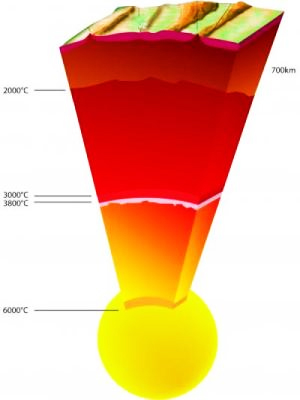
Variações de temperatura na Terra.

   Estas medições confirmam o motivo porque a Terra tem um campo magnético, determinado pelos modelos geofísicos que dizem que a diferença de temperatura entre o núcleo sólido e o manto superior deve ser de pelo menos 1500ºC. 
   A análise das ondas sísmicas pode dar informação sobre a espessura do núcleo sólido e líquido e sobre a forma como a pressão na Terra aumenta com a profundidade, no entanto, estas ondas não proporcionam informação sobre a temperatura.

   O núcleo da Terra é composto, principalmente, por ferro líquido a temperaturas superiores a 4 mil graus, sujeito a pressões de mais de 1,3 milhões de atmosferas. Nestas condições, o ferro é tão líquido como a água e só no centro da Terra, onde a pressão e a temperatura são ainda mais elevadas, o ferro solidifica. A diferença de temperatura entre o manto e o núcleo é a principal causa dos movimentos térmicos a grande escala. Estes movimentos térmicos aliados à rotação da Terra geram o campo magnético da Terra. 

   Para gerar uma imagem precisa do perfil da temperatura no centro da Terra, os cientistas observaram em laboratório o ponto de fusão do ferro a diferentes pressões, utilizando equipamentos de diamante para comprimir partículas de ferro a pressões milhões de vezes superiores à exercida pela atmosfera. Dispararam raios laser capazes de aquecer o material a 5000ºC. 
Tivemos de superar muitos desafios experimentais, uma vez que as amostras devem estar isoladas termicamente e não podem interagir quimicamente com o ambiente. Além disso, mesmo que uma amostra alcance as temperaturas e a pressão extremas do centro da Terra, isso só acontece por alguns segundos — período muito curto para determinar se o material está derretido ou sólido”, diz Agnès Dewaele.

   Os investigadores desenvolveram uma nova técnica na qual um intenso feixe de raios-x sonda uma amostra, conseguindo determinar se é sólida, líquida ou se está parcialmente fundida. Determinou-se, desta forma, que o ponto de fusão do ferro a uma pressão de 2,2 milhões de atmosferas é de 4800 graus. Depois, através de modelos matemáticos, calculou-se o ponto de fusão para 3,3 milhões de atmosferas, equivalente à sentida na fronteira entre o núcleo sólido e o líquido. O resultado foi de 6000ºC.


________________________
Adaptado de:


17 maio 2012

21 março 2012

New Theory about Formation of the Oldest Continents


The Earth's structure can be compared to an orange, that is, its crust is the peel supported by the earth's heavy mantle. That peel is made up of a continental crust with 30 to 40 kilometers thick, it is much lighter than the thinner oceanic crust and protrudes from the Earth's mantle because of its lower density, like an iceberg in the sea.

Fig. 1 - Scheme of the Earth's chemical and physical composition/structure (from right to left) (Portal São Francisco - http://www.portalsaofrancisco.com.br/alfa/placas-tectonicas/litosfera.php).

"According to the current theory, the first continental crusts were formed when tectonic plates would collide, submerging oceanic crusts into the Earth's mantle, where they would partially melt at a depth of approximately 100 kilometers. That molten rock then ascended to the Earth's surface and formed the first continents," says adjunct professor Dr. Thorsten Nagel of the Steinmann Institute of Geosciences at the University of Bonn, lead author of the study. The theory has been supported by the oldest known continental rocks, approximately 3.8 billion years old, found in western Greenland.

Fig. 2 - Earth's surface with the oldest continents (Terra Daily, News About Planet Earth - http://www.terradaily.com/reports/A_new_theory_on_the_formation_of_the_oldest_continents_999.html).


Following trace elements

The composition of the continental crust corresponds to a semiliquid version of the oceanic
crust melted by 10 to 30 percent of its original state. Unfortunately, the concentrations of the main chemical components in the re-solidified rock do not provide much information about what depth the fusion occurred at.

Prof. Dr. Carsten Munker of the Institute of Geology and Mineralogy at the University of Cologne explains, "In order to find that out, you have to know what minerals the remaining 70 to 90 percent of the oceanic crust consisted of". Researchers from Bonn and Cologne have now analyzed the Greenlandic rocks for different elements occurring at various high concentrations, also know as trace elements.

"Trace elements provide geologists with a window to the origin of continental crust," says Prof. Munker. "With their help, we can identify minerals in the residual rock that were deposited in the depths by the molten rock." Before the magma separated from the bedrock, the semifluid rock and the leftover solid minerals actively exchanged trace elements.

Dr. Elis Hoffmann from Bonn, coauthor of the study, explains, "Different minerals have characteristic ways of separating when trace elements are smelted. In other words, the concentration of trace elements in the molten rock provide a fingerprint of the residual bedrock". The concentration of trace elements in the oldest continental rock allows geoscientists to reconstruct possible bedrock based on their minerals and thus determine at what depth the continental crust originated.


The oceanic crust did not have to descend

Using computers, the scientists simulated the composition of bedrock and molten rock that would emerge from partially melting the oceanic crust at various depths and temperatures. 
They then compared the data calculated for the molten rock with the actual concentration of trace elements in the oldest continental rocks. "Our results paint a surprising picture," Dr. Nagel reports. "The oceanic crust did not have to descend to a depth of 100 kilometers to create the molten rock that makes up the rocks of the first continents." According to the calculations, a depth of 30 to 40 kilometers is much more probable.

The primeval oceanic crust could have "oozed" continents

...it could definitely have had the power to do so in the Archean Eon. Four billion years ago, the gradually cooling earth was still significantly warmer than it is today. The oceanic crust could have simply "oozed" continents at the same time that other geological processes were occurring, like volcanism, orogeny, and the influx of water.

The geologist from Bonn says, "We think it is unlikely that the contents were formed into subduction zones. Whether or not tectonic plates of the primordial earth had such zones of subsidence is still a matter of debate".

Adapted:

14 agosto 2011

A Terra poderá ter tido duas luas

Uma nova teoria, descrita num artigo publicado na revista Nature, sugere que a Terra poderá ter tido uma segunda Lua, mais pequena, que desapareceu numa colisão lenta com a sua irmã.

Há vários anos que os cientistas tentam perceber por que razão o lado visível da Lua é maioritariamente plano enquanto o lado oposto apresenta montanhas com mais de 3 mil metros.

Durante este tempo, têm sido propostas várias teorias para explicar o que determinou esta diferença na topografia lunar. Os últimos artigos publicados sobre o assunto referiam-se a uma série de colisões cósmicas durante um longo período de tempo.

Cientistas afirmam que a Terra foi atingida há cerca de 4 mil milhões de anos por um outro planeta do tamanho de Marte, numa teoria que ficou conhecida como Hipótese Impacto-Global. Os detritos resultantes poderão ter formado a amálgama de detritos que originou a Lua.

Uma equipa de cientistas refere agora, num artigo publicado na revista científica Nature, que a Terra poderá ter tido uma segunda Lua, mais pequena.

Martin Jutzi, da Universidade de Bern, na Suíça, é um dos autores deste artigo. Explicou que «quando olhamos para esta teoria não há nenhuma razão para se ter formado apenas uma Lua.»

Depois de estar «presa», durante milhões de anos, a pequena lua embarcou numa rota de colisão com a sua irmã. A colisão foi lenta, a uma velocidade inferior a 3 km/s, mais baixa que a velocidade do som nas rochas. «Isto é importante porque significa que não houve grandes choques ou fusão» durante o processo.

Na altura da colisão, a grande Lua teria um «oceano de magma» coberto com uma crosta fina. Os cientistas argumentam que o impacto terá levado à acumulação de material sobre a crosta lunar, o que formou as montanhas e, terá redistribuído o magma para o lado visível da lua. A redistribuição do magma é apoiada por observações da sonda lunar Prospector.

Maria Zuber, do MIT, sugere que o novo estudo «demonstra plausibilidade em vez de provas.» Os autores «aumentaram a possibilidade legítima que após um impacto gigante com a Terra talvez, fugazmente, possuía mais do que uma Lua.»

Os investigadores envolvidos neste estudo esperam que os dados detalhados das estruturas internas da Lua, obtidos pela sonda da Nasa, Lunar Reconnaissance Orbiter e, os mapas de alta resolução da missão Gravity Recovery and Interior Laboratory (GRAIL), irão fundamentar ou desafiar a sua teoria no próximo ano.

Por outro lado, aguardam por »uma amostra do lado escuro da Lua de uma missão tripulada [que] irá certamente ajudar a dizer qual a teoria mais provável.»


Adaptado de: Naturlink

11 julho 2011

New Force Driving Earth's Tectonic Plates

Steve Cande and Dave Stegman have now discovered a new force that drives plate tectonics: plumes of hot magma pushing up from Earth's deep interior. Their research is published in the July 7 issue of the journal Nature.

Using analytical methods to track plate motions through Earth's history, Cande and Stegman's research provides evidence that such mantle plume "hot spots," which can last for tens of millions of years and are active today at locations such as Hawaii, Iceland and the Galapagos, may work as an additional tectonic driver, along with push-pull forces.

Their new results describe a clear connection between the arrival of a powerful mantle plume head around 70 million years ago and the rapid motion of the Indian plate that was pushed as a consequence of overlying the plume's location. The arrival of the plume also created immense formations of volcanic rock now called the "Deccan flood basalts" in western India, which erupted just prior to the mass extinction of dinosaurs. The Indian continent has since drifted north and collided with Asia, but the original location of the plume's arrival has remained volcanically active to this day, most recently having formed Réunion island near Madagascar.

The team also recognized that this "plume-push" force acted on other tectonic plates, and pushed on Africa as well but in the opposite direction.

"Prior to the plume's arrival, the African plate was slowly drifting but then stops altogether, at the same time the Indian speeds up," explains Stegman, an assistant professor of geophysics in Scripps' Cecil H. and Ida M. Green Institute of Geophysics and Planetary Physics. "It became clear the motion of the Indian and African plates were synchronized and the Réunion hotspot was the common link."

After the force of the plume had waned, the African plate's motion gradually returned to its previous speed while India slowed down.

"There is a dramatic slow down in the northwards motion of the Indian plate around 50 million years ago that has long been attributed to the initial collision of India with the Eurasian plate," said Cande, a professor of marine geophysics in the Geosciences Research Division at Scripps. "An implication of our study is that the slow down might just reflect the waning of the mantle plume-the actual collision might have occurred a little later."
__________________________________________ 

07 fevereiro 2011

New Way to Calculate Age of Earth's Crust

A new way to calculate the age of Earth's crust has been developed by researchers from the University of Bristol and the University of St Andrews.

The continental crust is the principal record of conditions on the Earth for the last 4.4 billion years. Its formation modified the composition of the mantle and the atmosphere, it supports life, and it remains a sink for carbon dioxide through weathering and erosion. The continental crust therefore has had a key role in the evolution of the Earth, and yet the timing of its generation remains the topic of considerable debate.

It is widely believed that the juvenile continental crust has grown from the depleted upper mantle. One common way to assess when new crust was formed is to determine the radiogenic isotope composition of any crustal sample, and to compare its isotope signature with that of the depleted mantle. In other words, radiogenic isotopes can be used to calculate 'model ages' of crust formation, which represent the time since a crustal sample was separated from its mantle source.

The concept of 'model age' has been widely used in crustal evolution studies for the last three decades. However it is increasingly clear that using the isotope composition of the depleted mantle as a reference for the calculation of model ages of continental crust generation can lead to incomplete interpretations.

In a paper published in Science, Dr Bruno Dhuime of Bristol's School of Earth Sciences and colleagues describe a new methodology for the calculation of model ages, based on the isotope composition of the average new continental crust.

Dr Dhuime said: "Ages calculated this way are significantly younger than model ages calculated from the isotope composition of the depleted mantle. New ages obtained are more consistent with the geological record, which opens new perspectives in crustal evolution studies based on radiogenic isotopes."
_________
Source: Science Daily

06 outubro 2010

Nova idade da Terra

Um recente estudo britânico chegou à conclusão de que o nosso planeta é 70 milhões de anos mais novo do que aquilo que se supunha.